
Thought-Leading Fintech Session Predicts Big Changes on User Experience
Financial Technology, or ‘Fintech’, is on the cusp of something great.
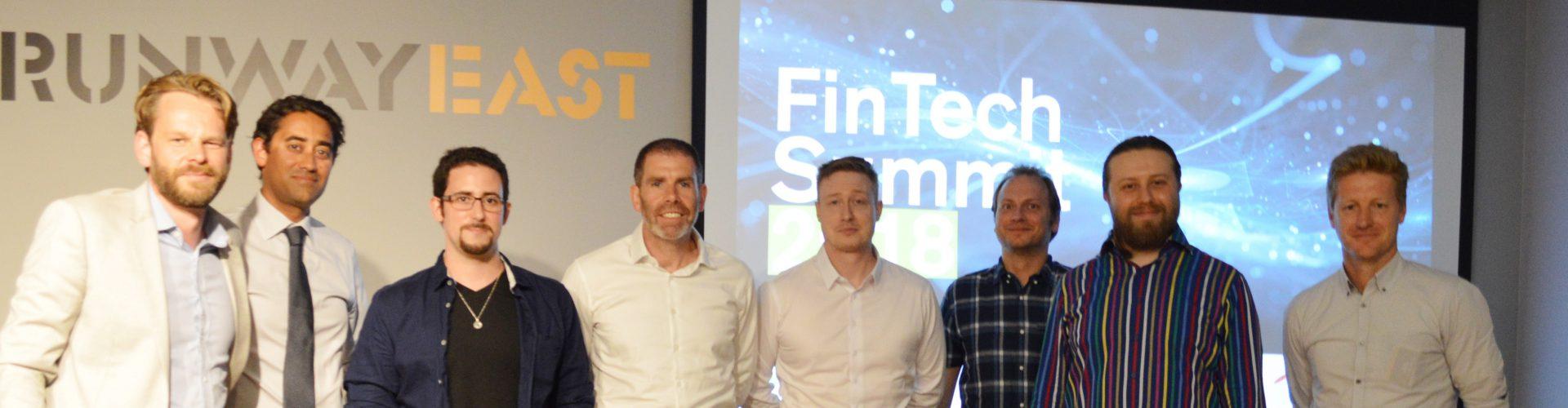
That was the message from a recent one-day workshop hosted by the University of Essex at Runway East. Industry leaders gathered to examine the current challenges and opportunities within the sector.
The event was in collaboration with Hood Group, which aims to contribute to the Fintech debate and essentially create a new industry. It marked a significant part of a new two-year collaboration between the two entities to develop a data strategy, supported by the government’s innovation agency, Innovate UK. This is crucial for Hood Group, as individuals are creating more data than ever before, and these snapshots have the potential to provide more personalised quotes, provided the information is safe and reliable.
With this in mind, the day included in-depth discussions on cybersecurity, data analysis, and even artificial intelligence. Specialists from Microsoft, Filament, Profusion, and Signal Media discussed topics such as artificial intelligence, UX, gamification, and cybersecurity in sessions that highlighted how far Fintech has recently progressed. The thought leaders expressed their excitement as they discussed the implications for everything from marketing to the future of the insurance industry.
Considering Growth
It was immediately apparent that the evolving landscape of Fintech in recent years, coupled with the introduction of GDPR, is pushing both consumers and professionals to understand more about the importance of their data and how companies use it. This is leading to a rapidly developing industry, often driven by customers themselves who might choose to ‘vote with their feet’ regarding the information they feel comfortable sharing.
In this sense, it’s the lack of understanding that is driving a new model. Dr Spyros Samothrakis, Assistant Director of the Institute for Analytics and Data Science at the University of Essex, said, “GDPR has forced people to unlock the black box of their AI – but for many, they don’t have the knowledge to interpret the model and explicitly understand how it is profiling or behaving. Ethics and transparency are now becoming considerations for companies.”
User Experience
There were some impressive statistics shared about the growth of Fintech and, intriguingly, the rise of chatbots. Henrik Nordmark, Head of Data Science at Profusion, predicted that by 2020, over 85% of interactions with financial institutions will be via chat. Interestingly, he compared artificial intelligence to its most child-like stage.
Despite the capabilities to automate many customer interactions with financial companies due to the number of predictable outcomes (e.g., finding a quote, accessing details, reporting an error), he believed that we need to let our AI systems figure this out for themselves and not be so prescriptive. He said, “With AI, it’s easy to give it a recipe book, and it will learn all the systems from the top-down, but with machine learning, we need a bottom-up approach. Don’t give it a lot of examples; instead, let it learn, exactly like a child.”
As Hood Group is a specialist in the use of technology and data to create truly personalised quotes, the team was keen to focus on their own digital strategy, especially concerning the likelihood of fraud, a topic dominating industry talks as big data — and big data leaks — continue to grow.
Hood Group’s Business Development Director, Paul Firkins, commented on the ability Fintech provides to retain customers, not just attract them. “It also helps us find solutions,” he said.
“Since working with the university, we’re also finding that these data developments have a positive impact on our company culture — AI and data developments help improve efficiency, such as automating pricing processes and reducing admin tasks. Our teams are trusting data and innovation experiments to make decisions and recommendations where they might have previously relied on the knowledge of a specific individual or process.”
The Role of Security
Phil Winstanley, Development Manager at Microsoft, spent his session explaining that IT isn’t just a desktop problem now. He said, “It’s an environment with interconnected and moving parts that all need protection.” He spoke of a large increase in the number of cyber threats (costing on average a whopping £8m per successful attack in the UK) and explained that Microsoft has turned to big data to predict patterns and protect users.
Although Winstanley acknowledged that hardware is only part of the solution, he added, “More than half of all threats are internal, by people using valid credentials, and that certainly makes it harder to solve. We still have to work with people and processes.”
Of course, there was also a generational consideration; the attitudes that younger people have towards their data, which Winstanley deemed ‘blasé’, means that businesses are having to change their own approaches to take into account the human factor.
Exciting Times Ahead
Despite the hurdles facing companies from security threats and the complicated relationships users have with their own data, the overwhelming takeaway from the day was one of positivity around Fintech and its vast capabilities for change, even growing with the users themselves.
CEO of Hood Group, Simon Hood, offers a sneak peek at just how that information might be used. He said, “I’d like to extend a huge heartfelt thanks to the people involved in putting today together. It is something that both Hood Group and the University of Essex would love to replicate as we believe that times certainly need to change.
“In our industry, the insurance industry, my company is known as a disrupter simply for using the data supplied by a customer themselves. We don’t believe this is disruption, we believe this is progress. And as long as we have the right methods in place to protect both ourselves and our customers, then the insurance industry can finally dig itself out of the dark ages and start putting their users at the heart of it.
“They say that information is key, but without someone to light the torch and follow, we’d simply not know where to begin. So, I have to thank the people here today for shining a light, and hopefully this will allow us to continue on our path to putting the customer first.”
Both Hood Group and the University of Essex expect to complete further sessions as funding allows.